
What Is Trade Finance?
by Axton Global

In the expansive realm of global trade, the intricate dance of goods and services across borders relies on a foundational element known as trade finance. This crucial aspect of international commerce serves as the financial engine that propels transactions, ensuring the smooth flow of goods and mitigating risks for both buyers and sellers. In this article, we unravel the essence of trade finance and its paramount role in the interconnected world of global trade.
Trade Finance Definition
At its core, trade finance encompasses a range of financial instruments and products designed to facilitate international trade transactions. Its primary objectives are to secure payment for exporters and guarantee the receipt of goods for importers, creating a framework that fosters trust and minimizes the inherent risks associated with cross-border commerce.
Key Components of Trade Finance
Letters of Credit
A cornerstone of trade finance, letters of credit provide a secure payment method. Issued by banks, they act as a contractual agreement, assuring the seller that payment will be made upon meeting specified conditions. This mechanism serves as a safeguard against non-payment and enhances the confidence of both parties involved.
Documentary Collections
An alternative to letters of credit, documentary collections involve the exchange of shipping documents through banks. While offering a more straightforward and cost-effective approach, it requires a foundation of trust between the buyer and seller. The bank acts as an intermediary, releasing documents upon payment or acceptance of a bill of exchange.
Open Account Transactions
In an open account transaction, the exporter ships goods with the expectation of receiving payment at a later date, often based on agreed-upon credit terms. While this method provides flexibility, it introduces credit risk. Proper credit assessment is crucial to ensuring the timely and secure flow of funds.
SINOSURE Credit Insurance and Trade Finance
China Export & Credit Insurance Corporation (SINOSURE) is China’s state-funded and policy-oriented export credit agency (ECA), established to promote international trade and foreign economic cooperation.
- What SINOSURE Insures: It covers risks of non-payment and financial default by foreign buyers, issuing banks, or borrowers under cross-border trade contracts and overseas investment projects.
- Who the Policy Protects: The policyholder and primary beneficiary is the Chinese entity—either the exporter (or a Chinese financing bank for long term insurance). Foreign importers do not purchase the policy directly; instead, they undergo a credit underwriting process (financial assessment) to establish an approved credit limit.
- Connection to Deferred Payment and Bank Financing: SINOSURE coverage mitigates credit risk for the Chinese exporter, making it viable and safe to extend commercial trade credit (deferred payment terms) to foreign buyers. Furthermore, the Chinese exporter can assign their rights of claim under the insured transaction to a commercial bank (rights of claim assignment), securing post-shipment export factoring or discounting immediately upon shipment.
Comparative Overview of Core SINOSURE Products
The table below outlines the primary insurance programs, their operational scope, and their role in structuring commercial transactions.
Risk Coverage and Policy Exclusions
1. Commercial and Political Risks
Commercial Risks:
Insolvency, liquidation, or declared bankruptcy of the foreign buyer or the letter of credit (L/C) issuing bank.
Protracted default—failure by the buyer to make contractual payment within the agreed grace and maturity windows.
Unjustified refusal to accept delivery of non-defective goods (under applicable short-term programs).
Political Risks:
Government-imposed foreign exchange moratoria, payment freezes, or currency transfer restrictions preventing remittance out of the buyer's jurisdiction.
War, civil commotion, revolution, or state acts preventing fulfillment of the export contract.
Expropriation, revocation of import permits, or statutory embargoes imposed after shipment.
2. Key Limitations and Exclusions
Commercial and Trade Disputes: SINOSURE does not indemnify losses if payment is withheld due to counterparty disputes regarding quality specifications, delayed dispatch, cargo damage, or volume shortfalls, until the underlying dispute is settled or legally adjudicated in favor of the exporter.
Unauthorized Credit Overruns: Shipments made in excess of the approved SINOSURE credit limit or executed after the expiry of the credit line are excluded from coverage.
Insured’s Fault or Non-Compliance: Any regulatory non-compliance, statutory violations of PRC export/customs law, or material breach of sales contract terms by the exporter voids policy protection.
Co-Insurance (Deductible/Retention): SINOSURE policies rarely cover 100% of the invoice face value; the exporter or lending institution typically retains a 10% to 20% co-insurance risk share.
Transaction Flow and Structural Roles
The following workflow illustrates a standard short-term transaction structured under open account deferred payment terms (Open Account / OA 90 Days):
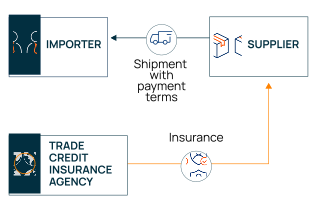
Risk Coverage (Trade Credit Insurance Agency to Supplier):
The trade credit insurance agency evaluates the importer's creditworthiness and issues an insurance policy to the supplier, safeguarding against losses caused by buyer default or non-payment.
Supply with Deferred Payment (Supplier to Importer):
Backed by insurance protection, the supplier confidently ships goods to the importer under deferred payment terms ("Shipment with payment terms", e.g., OA 60–90 days) without demanding 100% advance payment.
Coverage Terms, Premium Guidelines, and Official Resources
Coverage parameters and premium pricing depend on the product category, sovereign risk rating of the importer's country, buyer balance sheet strength, and credit tenor:
Short-Term Export Credit Insurance:
Tenor: Up to 360 days (commonly 30, 60, 90, 120, or 180 days).
Coverage Ratio: Standardly up to 80% – 90% for commercial risks and up to 90% for political risks.
Premium Rates: Base rates generally range between 0.3% and 1.5% of the invoice/contract volume, determined by country tiering and buyer underwriting score.
Official Resource: SINOSURE Short-Term Export Credit Insurance.
Medium & Long-Term (MLT) Export Credit Insurance:
Tenor: Typically 1 to 10–15 years (conforming with OECD Export Credit Arrangement guidelines for capital goods and infrastructure projects).
Coverage Ratio: Generally up to 85% – 95% of the eligible contract value (subject to a minimum 15% commercial advance payment made by the buyer).
Premium Rates: Determined per project by SINOSURE’s underwriting committee based on sovereign guarantees, bank aval, debt-service coverage ratios, and tenure.
Official Resource:SINOSURE Medium & Long-Term Export Credit Insurance.
Overseas Investment Insurance:
Tenor: Long-term coverage up to 15–20 years.
Coverage Ratio: Up to 90% of verified losses resulting strictly from political events (expropriation, war, cross-border remittance limits).
Official Resource: SINOSURE Overseas Investment Insurance.
Domestic Trade Credit Insurance:
Tenor: Short-term domestic trade terms (generally 90 to 180 days).
Coverage Ratio: Up to 80% – 90% of the eligible domestic commercial debt.
Official Resource: SINOSURE Domestic Trade Credit Insurance.
We help importers from all over the world to improve their trading terms with Chinese suppliers and extend payment terms to 90 or 120 days.
We provide comprehensive consulting services regarding trade credit insurance.
Our Services
-
- Credit limit approvalSinosure credit assessment and credit limit approval process to secure supplier trade credit.
-
Consulting
Advisory on Sinosure-related matters and structuring of complex supplier trade credit transactions.